① Why Today
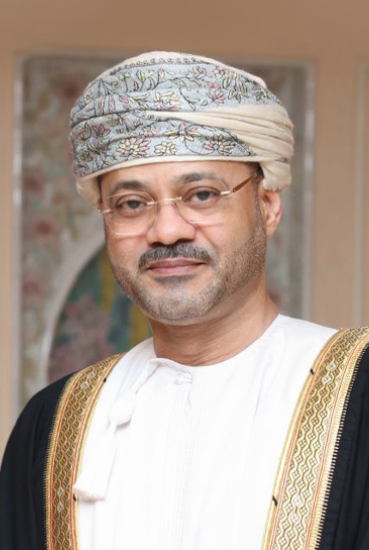
The man who bought today's 24-hour extension — still brokering while bombs fall
The man behind the backchannel that produced today's 24-hour extension — he flew to Washington 24 hours before Trump started the war to plead for diplomacy, and is still brokering with both sides while bombs fall.
Today's extension from the April 6 deadline to April 8 04:00 GST did not happen because Trump changed his mind. It happened because an active diplomatic channel — the Muscat back-channel that Busaidi runs — was carrying live traffic from Tehran. He is the operational reason the diplomatic window keeps reopening. Almost nobody outside of foreign ministries can name him. That asymmetry is the story.
② Background
Technocrat first, diplomat second. Badr bin Hamad Al Busaidi is not a politician who became a diplomat — he is a technocrat diplomat who ascended to the ministerial level. PhD from Oxford in economics, former Governor of the Central Bank of Oman, former Secretary-General of the Foreign Ministry before being appointed FM in 2020 under Sultan Haitham bin Tariq. He came to the role with a CV that reads as financial architect first, foreign policy executor second — which is precisely why he operates differently from almost every other FM in the region. He doesn't read geopolitics through ideology. He reads it through institutional survival.
Five decades of Omani doctrine — and its most sophisticated practitioner. Oman's foreign policy was built by Sultan Qaboos bin Said over five decades: never join a bloc, never close a door, never make an enemy you don't have to make. Busaidi is the most sophisticated practitioner of that doctrine alive. He has hosted US-Iran talks (the 2012-13 Muscat channel that led to the JCPOA), Houthi prisoner exchanges, Hamas negotiations, and Israeli back-channel discussions — all while Oman maintains full diplomatic relations with every party simultaneously. No other country in the region has this architecture, and almost no other FM could navigate it.
"A peace deal is within our reach … if we just allow diplomacy the space it needs to get there."
— Badr Al Busaidi, CBS Face the Nation, February 2026
The Central Bank background matters. His time as Governor of the Central Bank of Oman is not incidental to his foreign policy role — it is integral to it. He understands how oil revenues, sovereign wealth, and the mechanics of Hormuz-dependent trade translate into national power. When he negotiates, he is not calculating abstract diplomatic points. He is calculating institutional survival at a sovereign level. This is a rare combination in any foreign ministry.
③ Decision Style
Creates operational facts, not positions. Busaidi makes decisions by creating operational facts, not by announcing positions. His February 2026 CBS interview was the clearest example: he appeared to be a FM giving a media interview, but he was actually delivering a substantive briefing — "Iran has agreed to no nuclear material stockpile" — that constituted a public record of Iranian concessions. He chose CBS Face the Nation because it reaches Washington decision-makers directly. The "message to viewers" was actually a message to the White House. He calculates every statement's institutional destination before speaking.
Never threatens. Never postures. When he says "the door to diplomacy is still open," that is not a platitude — it is an operational signal that Muscat is still receiving traffic. When he says "this war is not of their making" about Iran, he is not expressing sympathy — he is maintaining the credibility that allows him to be believed when he says Iran is serious about a deal. The distinction between performative diplomacy and functional diplomacy is his entire operating edge.
The statement architecture. Every Busaidi public statement has a secondary audience baked in. Statements about Iran's seriousness are not for Iranian domestic consumption — they are calibrated to sustain the diplomatic window with Washington. Statements emphasising "both sides showing willingness" are not for Western audiences — they are for Iranian hardliners who need political cover to keep the channel open. He is running simultaneous messaging operations in a single paragraph.
④ Institutional Incentives
Why Oman Cannot Walk Away
🌊
Maritime border
Oman shares a maritime border with Iran across the Strait of Hormuz. This is not a diplomatic abstraction — it is a geographic fact that makes every Iranian threat to close the Strait an existential economic event for Oman, not a geopolitical abstraction. Sohar Port, Oman's primary industrial port, depends on Hormuz being open.
⛽
Oil revenues
Every ship that passes through Hormuz generates transit revenue, insurance premiums, and service fees that flow through Omani infrastructure. The Central Bank of Oman — which Busaidi ran — holds reserves denominated in oil revenues that flow through Hormuz-dependent channels. Iran closing Hormuz is not a geopolitical problem for Oman. It is an economic catastrophe.
🔒
Structural self-interest
Oman mediates Iran because it has a direct economic stake in the outcome. Unlike Qatar (which mediates for status) or Switzerland (which mediates as doctrine), Oman cannot afford for this channel to fail. Both parties know Oman will never walk away, because Oman can't. This structural constraint is what makes the Muscat channel more durable than any purely moral or status-based mediation.
🏛️
Institutional credibility
Oman's decades-long neutrality record means both Iran and the US have deep institutional memory of dealing with Muscat. The JCPOA's origin story runs through this channel. Busaidi inherits that credibility — he didn't build it from scratch in 2020, he stepped into a functioning architecture and has maintained it through conditions that would have destroyed any lesser channel.
⑤ Track Record
2012–2013 — The JCPOA Origin
Institutional inheritance: Busaidi's predecessor set up the secret Muscat channel that brought US and Iranian negotiators face-to-face for the first time in decades — producing the 2015 JCPOA. Busaidi himself, as Secretary-General of the Foreign Ministry, was part of the institutional architecture that made it happen. He stepped into the FM role already deeply familiar with the channel's mechanics.
2022–2023 — Houthi Prisoner Exchanges
Delivered when every other channel failed: Oman brokered multiple Houthi-Saudi prisoner exchanges when the UN, Qatar, and other mediators had hit walls. The exchanges produced meaningful humanitarian outcomes — thousands of prisoners — in a conflict that had otherwise seemed frozen. Track record: sustained mediation through a multi-year conflict with no end in sight.
Early 2026 — Three-Round US-Iran Architecture
Brokered Rome, Muscat, Geneva: Three rounds of indirect US-Iran talks — Rome, Muscat, Geneva — all ran through or were enabled by the Oman architecture. Secured Iran's agreement to a "no nuclear material stockpile" commitment, which Busaidi publicly called "unprecedented." This is the concession that created the diplomatic basis for the current negotiations.
February 2026 — Washington Before War
Flew to Washington on the eve of conflict: Busaidi travelled to Washington 24 hours before the US-Israeli strikes began, making the case personally for continued diplomacy. The strikes happened anyway — but the channel survived. He didn't leave. He kept the Muscat line open through active kinetic conflict, which is operationally unprecedented in recent Middle East diplomacy.
April 6, 2026 — Today
The extension that is today's lead story: Busaidi stated publicly that "the door to diplomacy is still open" even amid active US-Israeli strikes on Iran — a rare explicit operational signal that the Muscat channel is live and carrying traffic. The 24-hour extension that produced today's new April 8 deadline is the direct downstream effect of his channel remaining functional.
⑥ Red Lines
Red Line 1: Never take sides publicly — not once
Busaidi has never publicly taken a side in any conflict he is mediating. Not once. Even when Oman has clear interests — as with Iran and Hormuz — the public language is always neutral, forward-looking, and procedural. "The door remains open." "Both sides have shown willingness." This is not rhetorical caution. It is the structural requirement of running a channel that both sides trust simultaneously. The moment he is seen as more sympathetic to one side, the other side loses confidence in Muscat as a venue.
Red Line 2: Never let Oman be used as a platform for embarrassment
He has never allowed Oman to be used as a platform for one party to embarrass another. When Iran made public statements about concessions in Muscat, Oman said nothing. When the US characterised the talks in ways Iran disputed, Oman said nothing. This silence is not passivity — it is the protection of the channel's neutrality. Both parties need to believe that what is said in Muscat, stays in Muscat. Busaidi enforces that discipline absolutely.
Red Line 3: He is building a channel, not writing a narrative
The distinction between a mediator who wants credit and one who wants outcomes is revealed by their behaviour under pressure. Busaidi has consistently chosen channel preservation over visibility. He rarely gives interviews. When he does, they are operational — like the CBS Face the Nation appearance that was actually a message to Washington. He does not need his name in the lead. He needs the deal to be possible.
⑦ Current Posture
What Busaidi is doing as of April 6, 2026
1
Active conduit for the April 8 deadline management. The 24-hour extension that produced today's Dhuhr lead was not spontaneous — it followed discussions with Iranian officials that structurally almost certainly ran through Muscat. Busaidi is the operational node through which Trump's deadline management and Iran's serial extensions are being coordinated.
2
Holding the line on the "door remains open" framing. His public language is calibrated to maintain diplomatic space for both sides before the April 8 04:00 GST deadline. Each "door remains open" restatement is not a platitude — it is an operational signal to Tehran that the Muscat channel is still functional and Washington is still receiving through it.
3
In contact with both sides simultaneously. The structural feature of the Muscat channel is that it is the only node that speaks to both Washington and Tehran with equal institutional credibility. Busaidi's current role is to transmit, not to originate — he is not proposing solutions, he is ensuring that proposals generated elsewhere reach the right ears in a form that doesn't poison the channel.
4
Watch for a signal before the deadline. His next move will likely be a quiet operational indicator — a statement, a visit, or a public comment — calibrated to keep the space open ahead of April 8. A Muscat-Tehran or Muscat-Washington trip in the next 24-36 hours would confirm active shuttle diplomacy at the critical moment.
⑧ What to Watch
- Any Omani public statement in the next 24-36 hours. A "door remains open" restatement from Busaidi before the April 8 deadline is the signal that the channel is still carrying traffic. Silence from Muscat would be the unusual and concerning development — it would suggest the channel has gone dark or that Busaidi has been told to stand down.
- Does Busaidi travel? A Muscat-Tehran or Muscat-Washington itinerary in the next 24 hours confirms active shuttle mediation at the critical moment. Travel is his most decisive operational signal — it means the channel has something to carry that requires in-person delivery.
- What Iran says about Oman. If Iranian hardline media begins characterising the Muscat channel as a US instrument or questioning Oman's neutrality, the IRGC faction is trying to close the diplomatic lane before the deadline by delegitimising the mediator. Watch whether Araghchi publicly defends the Oman channel — that would be the counter-signal.
- Any Omani economic signal. A change in Sohar Port operational status, insurance premium shifts on Gulf shipping lanes, or any Central Bank of Oman statement about oil market conditions would be a secondary indicator of how Oman is reading the risk environment heading into the April 8 deadline.
⑨ Lore's Lens
The structural read
Busaidi is arguably the most consequential person in the Iran crisis who almost nobody outside diplomatic circles can name. The Oman channel has now been operational for over a year — producing actual concessions (the no-stockpile commitment), surviving the outbreak of war, and now managing the serial deadline extensions. Every time Trump resets the clock instead of pulling the trigger, there is an Omani phone call somewhere in that story.
The analytical insight that most coverage misses: Busaidi's neutrality is credible precisely because it is forced. He cannot be seen as sympathetic to Iran because that would close Washington's use of the channel. He cannot be seen as Washington's instrument because that would close Tehran's use of it. His constraints are perfectly balanced — and both parties know it. This is not moral virtue. It is structural necessity that produces the same behavioural outcome as moral virtue. That is what makes Muscat uniquely reliable as a venue.
The region has many mediators who perform mediation — who hold press conferences, issue joint statements, and collect the diplomatic visibility that comes with being seen as a peacemaker. Busaidi does none of that. He is interested in outcomes, not credit. In a region full of mediators who perform mediation, he actually mediates.
The critical variable for the next 48 hours: can Busaidi sustain the channel's functionality under a hard April 8 deadline with Trump's most explicit public threats in the crisis? Every prior deadline extended because the channel was still producing movement. The question is not whether Busaidi can keep the door open — he has done that through active bombing. The question is whether there is anything on the other side of the door that both principals are willing to walk through.
⑩ The Hidden Layer
What almost nobody mentions
Here is what almost nobody mentions: Oman has a direct equity stake in the Strait of Hormuz functioning. The Sohar Industrial Port is one of Oman's primary economic assets — it handles container shipping, petrochemical exports, and transshipment cargo whose value depends entirely on Hormuz being open. The Central Bank of Oman, which Busaidi used to run, holds reserves denominated in oil revenues that flow through Hormuz-dependent channels. When Busaidi fights for a deal, he is not being noble or idealistic — he is protecting Omani sovereign wealth and economic infrastructure.
This is the Hidden Layer: Oman's mediation is not charity. It is structural self-interest dressed as diplomacy. And because both Iran and the US understand this — they know Oman has skin in the game, not just reputation — the channel has a credibility that purely altruistic mediators cannot match. Both sides believe Oman will never sandbag the process, because Oman can't afford to.
The second hidden layer: Busaidi's tenure as Central Bank Governor gave him a reading of Iranian economic vulnerability that most foreign ministers don't have. He knows exactly how much the oil sanctions are costing Iran in real sovereign revenue — not the political talking points, the actual cash flow numbers. When he tells Iranian interlocutors that a deal has economic urgency, he is not bluffing. He has modelled it. And when he tells Washington that Iran's economic pain threshold is real but not infinite, he has the institutional knowledge to be believed. He is the only FM in the region who can credibly translate between the economic logic of the deal and the political logic of the deal simultaneously — because he has operated at the apex of both systems. That combination is irreplaceable.
Sources
Full Transcript: Omani FM Badr Al Busaidi on CBS Face the Nation — "Iran has agreed to no nuclear material stockpile"
CBS News · February 2026
Peace within reach as Iran agrees no nuclear material stockpile, Oman FM says
Al Jazeera · 28 February 2026
Iran and US hold talks in Oman as fears of war hang over region
Al Jazeera · 6 February 2026
"War not of their making" — Omani FM Busaidi on Iran
Middle East Eye · March 2026
Oman says door to diplomacy remains open amid US-Israeli strikes on Iran
Anadolu Agency · 2 March 2026
Badr bin Hamad Al Busaidi — Wikipedia
en.wikipedia.org/wiki/Badr_bin_Hamad_Al_Busaidi