📖 Lore Intelligence · Person to Know · Maghrib Brief 5 April 2026
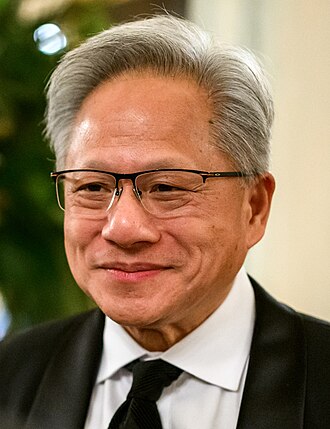
Jensen Huang
Founder & CEO, NVIDIA — since 1993 · Taiwanese-American · Born 1963
NVIDIA
5 April 2026
20-Minute Deep Dive
Jensen Huang co-founded NVIDIA in 1993, aged 30, with $200 and a plan to build graphics chips for video games. He has been CEO ever since. That tenure — over three decades at the same company he started — is almost without precedent in the modern technology industry. Most founders who last that long either go public and step back, or build something that becomes a utility and fades into infrastructure. Huang did neither. He kept building.
NVIDIA's original product was the GPU — a processor designed to render graphics quickly by running thousands of small calculations in parallel rather than a few large ones in sequence. This parallel processing architecture, irrelevant for most computing tasks in the 1990s, turned out to be exactly what machine learning needed three decades later. The H100 and B200 chips that power every significant AI model today — GPT-4, DeepSeek, Gemini, Llama — are the direct descendants of chips Huang designed to render pixels faster.
He is 61. He still delivers NVIDIA's keynotes in a leather jacket. He still talks about the company as if it is one bad quarter from extinction. He is worth approximately $164 billion, making him the seventh-wealthiest person on Earth. He describes his management style as "a thousand direct reports" — the idea that senior leadership should be accessible to everyone without a formal hierarchy. Whether this is true or a founder myth is debated internally. What is not debated is that NVIDIA, under his leadership, became the most important technology company of the 2020s without planning to.
These three stories are not independent. They are the three corners of the same structural problem. The US-China semiconductor war is reshaping which chips NVIDIA can sell where. DeepSeek's efficiency gains are reshaping how many chips any AI system needs. And the Gulf's AI ambitions are the fastest-growing new market that could partially compensate for China revenue losses — but only if the US government allows full-specification chip sales to Gulf buyers, which it is currently scrutinizing carefully.
Huang didn't engineer this convergence. It arrived at his company from three directions simultaneously. He has to navigate all three in real time while building the next generation of chips.
The numbers tell the structural story. China was historically NVIDIA's largest market — estimates range from 25-40% of total revenue depending on how you count indirect Chinese purchases through Hong Kong entities. Export controls enacted in 2022, tightened in 2023, and extended in 2026 have dramatically reduced direct Chinese access to NVIDIA's most powerful chips.
The US government relationship is not a customer relationship — it is a regulatory ceiling. The Commerce Department's Bureau of Industry and Security defines what chips NVIDIA can ship internationally and at what compute threshold. When the H100 was restricted, NVIDIA created the H800/A800 for the Chinese market at lower specifications. When those were restricted, NVIDIA had to redesign again. Every regulatory revision creates a new product engineering problem.
The Gulf is the emerging story. Saudi Arabia's Humain AI initiative, the UAE's Mohammed bin Zayed AI University, Qatar's national AI strategy — all of them require massive compute infrastructure that currently runs on NVIDIA hardware. The deals being discussed at Dubai AI Week are among the largest AI infrastructure procurement contracts of 2026. But the US government is watching Gulf chip purchases carefully for signs of re-export to China, which adds a compliance layer to every Gulf deal.
Huang has been called before Congress, sanctioned in China, and feted in the UAE all in the same quarter. The man who built a chip company for gaming accidentally became the most geopolitically consequential CEO alive.
His personal position is structurally impossible. He needs China: historically 40%+ of NVIDIA's revenue came from Chinese customers — data centres, research institutes, tech companies. He needs the US government: export controls define his product ceiling. Which chips can be sold to whom, at what compute level, determines what NVIDIA can offer which market. The H100 was restricted to China in 2023. The A800 workaround was then restricted. Every restriction forces a new calculation.
He needs the Gulf: his biggest new markets, because the GCC states are buying AI infrastructure at scale and NVIDIA hardware is the primary vendor. But a chip sold to the UAE at full specification may be re-exported to China — Washington is watching. A chip withheld from China to comply with export controls costs revenue and drives Beijing toward Huawei's Ascend chips, which close the gap faster when NVIDIA isn't competing. A chip sold to Saudi Arabia's NEOM project generates Gulf revenue but raises questions about AI capability diffusion the Pentagon wants to control.
He cannot fully please any of them. The China relationship costs him US government goodwill and potentially his export licences. The US government relationship costs him China revenue and forces expensive product redesigns. The Gulf relationship generates growth but triggers US compliance scrutiny that can delay or block deals.
The leather jacket is not an affectation. It is a deliberate signal: I am a technologist, not a diplomat. I am building chips, not making foreign policy. The consistent visual identity across every keynote, every congressional hearing, every Gulf summit — leather jacket, no tie — is Huang maintaining the only neutral ground he has left. The moment he starts dressing like a statesman, he becomes one. He cannot afford that.
This is not conventional corporate strategy. This is a founder trapped by the success of the thing he built, forced to make decisions with geopolitical consequences while pretending — for everyone's benefit, including his own — that he is still just making chips for AI training runs.
The triangulation is not a problem he can solve. It is the permanent condition of running the infrastructure layer of a technology that every major power wants to control. Huang's job in 2026 is not to win — it is to keep all three relationships functional enough that NVIDIA remains the default vendor while the geopolitical rules are still being written.