Before dawn on the Arabian Gulf, a dhow captain does what dhow captains have always done. He reads the water. He watches the radar. He adjusts his course — not because anything is wrong, but because these waters require it. This morning, an Iranian naval vessel holds position three nautical miles to the west. He notes it. He plots around it. He continues toward Muscat.
His cargo is electronics, garments, dried goods. His route runs from Dubai to the port at Muttrah, as it has run for generations — the same arc of coastline, the same prevailing winds, the same judgement calls at the same chokepoints. The vessel that flagged him is new. The electronics in his hold are new. But the calculation he made — carry the goods, avoid the confrontation, keep moving — is not new at all.
It is, as it happens, approximately 5,000 years old.
In 1959, an archaeological team excavating a small island off the coast of Abu Dhabi uncovered something that should have changed how the world understood this region. The island was Umm Al Nar. What they found inside its circular stone tombs was not a local culture buried in isolation. It was a trade network.
Copper from the Hajar Mountains of Oman. Pottery fired in kilns along the Indus River — in what is now Pakistan, more than 2,000 kilometres east. Carnelian beads from Gujarat. Chlorite vessels in a style found across Mesopotamia, in what is now Iraq, to the northwest. All of it in one island's tombs. All of it from between 2600 and 2000 BC — before the pyramids at Giza were complete, before the first dynasty of Babylon rose, centuries before Moses.
The people of Umm Al Nar were not on the edge of the ancient world. They were its crossroads. Three civilisations — Mesopotamia, the Indus Valley, the Arabian Peninsula — were flowing through this point simultaneously. Not sequentially. Simultaneously. The intersection was not incidental. It was structural. The geography made it inevitable, and the people here built an economy around that inevitability.
A Bronze Age culture centred on an island in Abu Dhabi — now connected to the mainland. Their tombs contained goods from three separate civilisations: copper and pottery traced to Oman, vessels from Mesopotamia, goods fired in Indus Valley kilns. The burial goods of one small island prove a trade network that predates everything most people associate with ancient history.
This was the name the Mesopotamians gave to the region that is now the UAE and Oman. In Sumerian texts, Magan appears repeatedly — and always in the same role. It was the source. Copper from Magan was not a trade luxury. It was infrastructure. Without Magan's copper, the Bronze Age empires of Mesopotamia could not make their tools, their weapons, their agricultural equipment. The empires that built cities by the Euphrates and the Tigris depended on metal that was extracted, processed, and shipped from this coastline. The UAE was not peripheral to the Bronze Age. It was load-bearing.
The Epic of Gilgamesh is the oldest surviving written narrative in human history. In it, a semi-divine king searches for immortality after watching his closest companion die. His journey takes him to Dilmun — described as a paradise, a sacred land, the place where the sun rises, a land of pure water untouched by sorrow. The Sumerian tablets identify Dilmun as a source of copper and a place of immense spiritual significance.
Whether Dilmun refers to Bahrain, to the eastern coast of Arabia, or to the broader Gulf region is debated. What is not debated is this: the region that is now the UAE was so embedded in the consciousness of the ancient world that it entered its founding story. When humanity first sat down to write a tale about what it means to live, to lose, to search — the Gulf was already in the story. Not as a setting. As a destination. A place of meaning.
Three names. Three windows into the same structural fact. This coastline — this specific stretch of shore running from what is now Ras al-Khaimah down through Abu Dhabi and into Oman — was the place the ancient world passed through. It controlled copper. It sat between sea routes. It offered shelter and water and exchange in a geography that offered little of any of those things in abundance. The empires did not come here because they wanted to. They came because they had to.
The Mesopotamians traded here — they had no choice. The Indus Valley merchants came here — the winds and the currents of the Arabian Gulf made this the natural waypoint on their route westward. The Persians understood the strategic value of the Gulf and pressed south into it, but found the interior of the peninsula ungovernable and the local maritime economy too diffuse to capture. The Sassanids tried harder. The Portuguese arrived in the sixteenth century with warships and imperial ambition and managed to extract tribute from Hormuz for a century before the economics broke down. The British came with treaties and trading posts and held the Trucial Coast under informal empire for 150 years — but even they did not govern it. They administered it from offshore. The Americans built a naval base at Bahrain and positioned aircraft carriers in the Gulf — but they too negotiate access rather than exercise control.
The pattern is not coincidence. It is geography writing policy. The Gulf is long and narrow and surrounded by land that is difficult to hold. The maritime economy that runs through it requires a kind of distributed flexibility — many ports, many traders, many flags — that resists the kind of centralised control that empires prefer. Every power that tried to own the Gulf found, eventually, that it could only rent access. The landlord has always been the water and the people who know how to read it.
The pattern that emerges across five millennia is not complicated. It is simply easier to see from this distance than from inside the present moment.
Each of those powers arrived with a theory of control. Each found the crossroads resilient in a way that defied the theory. The crossroads does not resist — it accommodates. It charges passage. It trades with the conqueror as readily as with the competitor. And when the empire recedes — as they always do — the crossroads is still there, accommodating whoever comes next. Not because it is weak. Because it is structurally indispensable.
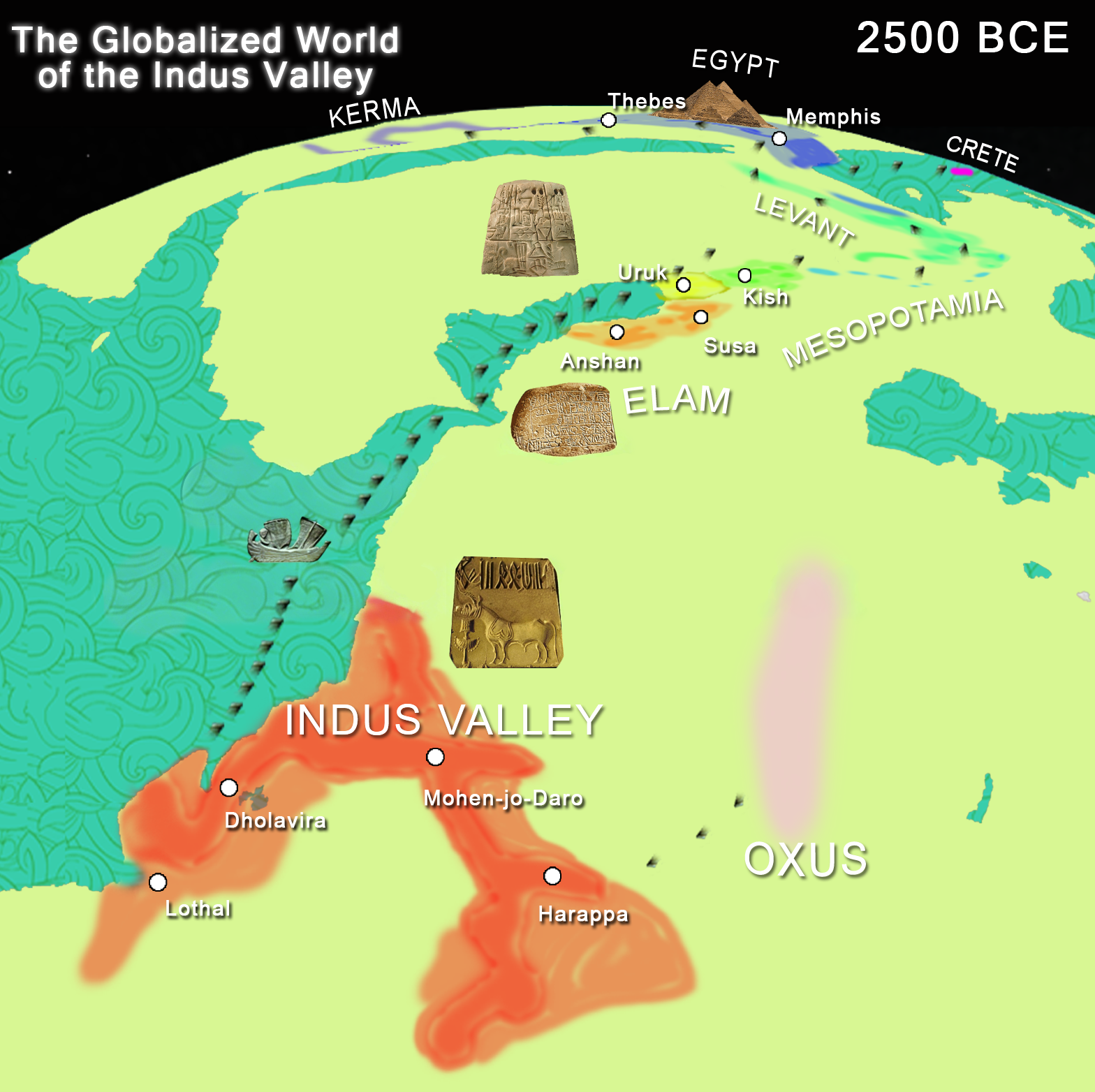
Bronze Age trade routes, c. 2600 BC — the sea route via the Arabian Gulf connecting Mesopotamia, Magan (UAE/Oman), and the Indus Valley civilisation. Source: Wikimedia Commons.
This ground is there. You can stand on it. Most people living in the UAE never have.
The crossroads doesn't choose sides. It charges passage. It always has.
The UAE's silence during the Iran-Israel war — the studied neutrality, the refusal to pick a lane, the continuation of business through the conflict — is not modern diplomatic sophistication. It is not calculated geopolitical branding. It is the oldest reflex this land knows: stay open, stay useful, let the powers fight around you. The crossroads has watched empires come and go for five millennia. It knows they are temporary. The trade is not.
Dubai AI Week opening during a regional conflict is not tone-deafness. It is the logic of the crossroads, applied to the twenty-first century. While the political world divides, the hub expands its offer. It is what Umm Al Nar was doing in 2600 BC — trading with the Indus Valley and Mesopotamia simultaneously, regardless of whatever those civilisations were doing to each other at the time. The neutrality is structural, not strategic. The structure is ancient, not invented.
When analysts struggle to explain why the UAE won't fully align with Washington or Riyadh or Beijing, they are solving the wrong problem. The UAE is not failing to choose. It is doing exactly what this geography has always done: making itself indispensable to all parties simultaneously. That is not a limitation. It is the product.
- When the UAE speaks during a regional crisis — takes a position, breaks the studied neutrality — that moment will be historic. Not because speech is unusual. Because meaningful silence has been the 5,000-year default. When the crossroads decides the cost of silence exceeds the cost of position, the calculation will have been running for a long time. Watch for it.
- The archaeological record at Umm Al Nar is still being excavated. Each season adds to the picture. What has already been found is enough to reframe the UAE's present. What remains underground may deepen it further.
- The question of whether the UAE can hold its crossroads position as the US-China competition forces harder binary choices on every trading nation — that is the 5,000-year logic being stress-tested in real time. Whether the structure holds under modern pressure is the open question of this generation.