① Why Today
The quiet hand building the legal architecture while the missiles fly
Al Zayani authored the GCC-backed UN Security Council resolution demanding Iran halt attacks on merchant vessels and civilian infrastructure. The vote is April 8 — the same day as Trump's deadline. One man is building the post-war legal framework while the crisis is still live.
If the resolution passes: the resulting co-sponsor/abstention map reveals which countries accept the "Iran as sole aggressor" legal frame. That map is the post-war coalition — assembled before the war ends. As former Secretary-General of the GCC (2011–2020), Al Zayani carries the institutional trust of all six Gulf states. He is not making news. He is making the structure within which news will be made for years.
② Background
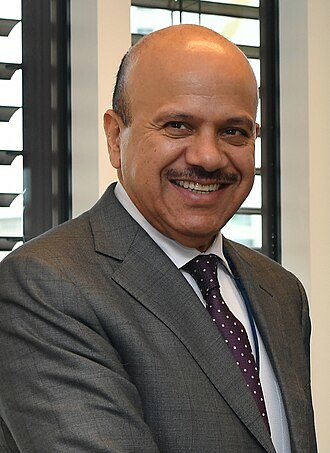
Soldier, diplomat, institution-builder — in that order. Dr. Abdullatif bin Rashid Al Zayani is a rare combination in Gulf diplomacy: a military man who became an institution-builder. He holds a PhD in International Relations from Exeter, served as a Royal Bahraini Army officer before transitioning to diplomatic roles, and spent nearly a decade at the apex of Gulf multilateral diplomacy as Secretary-General of the GCC. He came to the Bahrain FM role in 2020 with a track record that no other Gulf FM could match: he had already managed the institutional architecture of six sovereign governments simultaneously.
Nine years at the GCC — spanning the Gulf's most fractious decade. Al Zayani served as GCC Secretary-General from 2011 to 2020 — a period that included the Arab Spring, the Bahrain protests (2011), the Qatar blockade (2017–2021), the Yemen conflict, and the rise and partial fall of ISIS. His mandate required him to keep six divergent sovereign states aligned on common institutional positions while each pursued its own national interests. He was not a diplomat in one bilateral relationship — he was the institutional spine of a six-state bloc during its most fractured decade.
The Qatar blockade as his defining test. The 2017 Qatar blockade nearly destroyed the GCC as an institution. Four member states (Saudi Arabia, UAE, Bahrain, Egypt) cut relations with Qatar; two (Kuwait, Oman) stayed out of the dispute and attempted mediation. Al Zayani's task as Secretary-General was to maintain the institution's formal existence while four of its six members were in open political confrontation with a fifth. He succeeded — the GCC did not formally fracture. That survival, quiet and largely uncelebrated, is his most significant institutional achievement. It is what makes him credible to every Gulf FM now: he has held the bloc together under conditions that would have shattered a less disciplined Secretary-General.
"The GCC is not just a political organisation — it is the expression of a shared destiny."
— Dr. Abdullatif Al Zayani, GCC Summit, Riyadh, 2019
Bahrain's FM role: small state, structural leverage. Bahrain is the smallest GCC state by population and territory. Its FM should, by normal logic, carry limited weight in multilateral forums. Al Zayani inverts this: his GCC institutional knowledge means he understands the internal positions of all six Gulf states better than most of their own FMs. He knows where the consensus lies, where it is performative, and where it is real. This is why Bahrain was chosen to author the UN resolution — not because Bahrain has Security Council weight, but because Al Zayani has the GCC alignment credibility to make the resolution hold across all six states simultaneously.
③ Decision Style
Framework builder, not position taker. Al Zayani does not make news — he makes frameworks. His decision-making style is institutional: identify the lowest common denominator that produces a workable alignment, build it into a document, and let the document do the political work. The GCC years taught him that you cannot force six sovereigns to agree — you can only find the architecture that allows them to act in parallel without formal contradiction. The UN resolution is this technique applied at a global scale.
Consensus-building in fracture conditions. The Qatar blockade showed his operating method under pressure. When four states were in open confrontation with a fifth, he did not attempt to mediate or resolve — he maintained the institutional architecture that would allow resolution when the principals were ready. He is not a fixer or an acute mediator (that is Busaidi's role). He is the structural engineer: he builds the rooms in which deals happen. His contribution to this crisis is not the back-channel — it is the legal framework that will define the back-channel's outcome.
Operates in the space between visible and structural. Almost no Western media has reported on the Bahrain-drafted UN resolution in the context of the April 8 crisis. Al Zayani is doing his most important work in the blind spot of the dominant coverage frame, which treats this as a US-Iran bilateral confrontation. He is building a multilateral legal architecture — quietly, in parallel — that will shape the post-war order regardless of whether Western audiences notice it while it is happening.
④ Why Bahrain
Why Bahrain Authors This Resolution
🏛️
GCC credibility
Al Zayani's nine years as GCC Secretary-General means he carries the institutional trust of all six member states in a way no current GCC FM does. When Bahrain authors a GCC resolution, the other five states sign on with minimal friction — because they know Al Zayani's drafts reflect genuine consensus, not one state's preferred framing.
🌊
Proximity to Iran
Bahrain sits directly across the water from Iran — closer than any other GCC state. Iranian influence operations in Bahrain are documented and ongoing. For Bahrain, the "Iran as aggressor" legal frame is not an abstract diplomatic position — it is a national security interest. Authoring this resolution is the most direct action Bahrain can take against Iranian influence outside its own territory.
🇺🇸
US Fifth Fleet
The US Fifth Fleet is headquartered in Manama, Bahrain. Bahrain's security depends structurally on US military presence. Bahrain has the most direct institutional interest of any GCC state in a legal framework that aligns with US strategic objectives in the post-war settlement. The resolution is not just a diplomatic contribution — it is Bahrain securing its position in the post-war architecture.
⛽
Economic exposure
Bahrain's oil refinery at Sitra processes Saudi crude that arrives via the Abu Saafa field and the BAPCO pipeline. Any disruption to Gulf shipping or Iranian attack on Gulf infrastructure directly threatens Bahrain's primary revenue stream. The resolution's demand that Iran "halt attacks on oil facilities" is specifically protective of Bahraini economic infrastructure.
⑤ Track Record
2011 — Assumed GCC Secretary-General
Took the helm in the Arab Spring's opening year: Assumed the GCC Secretary-General role in the same year Bahrain experienced its own protest movement, which the GCC suppressed through the Peninsula Shield Force. Al Zayani managed the institutional aftermath — keeping the GCC's external credibility intact while its own member state faced domestic upheaval. Track record: institution management under simultaneous domestic and regional crisis.
2015 — Yemen Coalition Alignment
GCC institutional coherence through the Yemen intervention: The Saudi-led Yemen coalition required GCC institutional alignment. Al Zayani managed the formal GCC position through the opening years of the Yemen conflict — maintaining the bloc's stated unity while Oman quietly stayed out of the coalition. Managing an opt-out without a formal fracture is a precise institutional skill. He did it.
2017–2020 — Qatar Blockade Survival
Held the institution together through its greatest fracture: The Qatar blockade split four GCC states against one, with two standing aside. Al Zayani maintained the GCC's formal institutional existence through three years of open inter-member political warfare. The Al-Ula Declaration (January 2021) — which ended the blockade — was only possible because the institutional architecture Al Zayani preserved gave the parties a mechanism to return to. He did not resolve the blockade. He kept the room intact until it could be resolved.
2020 — Appointed Bahrain FM
Transition from multilateral to bilateral: Moved from GCC Secretary-General to Bahrain's FM under King Hamad. The appointment gave Bahrain a FM with nine years of GCC institutional knowledge — an asymmetric advantage in Gulf diplomacy. He immediately became one of the few Gulf FMs who could speak credibly for the GCC position as a whole, not just his own state's interests.
April 2026 — UN Security Council Resolution
Authored the GCC-backed UNSC resolution on Iran: Drafted the resolution demanding Iran halt attacks on merchant vessels and civilian infrastructure, secured GCC + Jordan co-sponsorship, and set the April 8 vote — the same day as Trump's deadline. This is his most consequential diplomatic document: it frames the international legal architecture for the post-war settlement before the war ends.
⑥ The Resolution — What It Actually Does
Legal Frame: Iran as Sole Aggressor
The resolution frames Iran as the unilateral aggressor against international maritime commerce and civilian infrastructure. If it passes, this framing enters the UN's formal record. Every subsequent post-war negotiation — Hormuz governance, sanctions relief, regional security architecture — starts from a baseline where Iran's actions are legally characterised as aggression against an international norm, not a response to military provocation. This is not symbolic: it is the legal foundation for the post-war order.
Co-Sponsor Map = Post-War Coalition
The vote's real signal is not pass/fail — it is the co-sponsor/abstention map. Which countries co-sponsored? Which abstained? Which voted against? That map reveals who accepts the "Iran as sole aggressor" frame in international law — and that is the post-war coalition that will negotiate, pressure, and settle with Iran when the shooting stops. Al Zayani is assembling the coalition now, before the war ends, by forcing every UN member to declare a position.
Russia/China Veto Changes Everything
If Russia or China vetoes, the legal architecture collapses — and the post-war settlement reverts to bilateral US-Iran negotiation without a multilateral legal frame. A veto would validate Iran's position that the attacks on shipping are a legitimate response to aggression, not unprovoked aggression themselves. Al Zayani's resolution is high-stakes: it either builds the legal foundation for the post-war order, or it exposes the limits of GCC multilateral leverage in the current global order.
⑦ Current Posture
What Al Zayani is doing as of April 7, 2026
1
Finalising co-sponsorship alignment ahead of the April 8 vote. The last 24 hours before a UN Security Council vote are when co-sponsorship commitments are secured or lost. Al Zayani will be in contact with every GCC + Jordan counterpart — and likely reaching beyond GCC to secure additional co-sponsors from Asia, Africa, and Europe. Each additional co-sponsor strengthens the legal frame's universality claim.
2
Coordinating with Washington on vote timing and language. The resolution's relationship to Trump's April 8 deadline is not accidental. The vote is scheduled for the same day. Al Zayani will have aligned the vote's timing with the US position — a pass at the Security Council gives Trump an international legal backing for any strike decision; a veto gives Iran a legal shield. The timing is the architecture.
3
Managing Oman's position quietly. Oman — the GCC's back-channel to Iran — has not co-sponsored the resolution. This is deliberate. Oman cannot be seen as endorsing a legal frame hostile to Iran while simultaneously running the diplomacy that might avert a strike. Al Zayani will have managed this gap privately — ensuring the GCC's legal action and Oman's diplomatic action do not formally contradict each other.
4
The resolution is the long game, not the immediate play. Al Zayani knows the resolution may not prevent a strike on April 8. Its purpose is not immediate de-escalation — it is post-war legal architecture. He is playing a longer game than the 20-hour deadline. The resolution matters most if there is a war and a settlement to be reached. He is preparing for that scenario now.
⑧ What to Watch
- April 8 vote outcome — pass or veto. This is the binary that defines the resolution's impact. A pass with broad co-sponsorship establishes the "Iran as sole aggressor" frame in international law. A Russian or Chinese veto exposes the limits of GCC multilateral leverage and returns the post-war settlement to bilateral US-Iran dynamics.
- Who co-sponsored and who abstained. The co-sponsor/abstention map is more informative than the vote outcome itself. Watch specifically: India (non-aligned, large Hormuz stake), Japan (Hormuz-dependent), and any EU members. Their positions reveal who accepts the GCC's framing of Iran as aggressor — and that is the post-war coalition.
- Oman's public stance on the resolution. If Oman publicly distances itself from the resolution — or signals non-support — it reveals that the GCC's legal action and its back-channel diplomacy have come into tension. Watch whether Muscat issues any public statement about the vote before April 8.
- Any Iranian response specifically naming Bahrain or Al Zayani. If Iran's foreign ministry singles out the Bahraini resolution in its formal response, it elevates the resolution's significance and signals Tehran understands the legal architecture being built against it. Silence from Tehran about the resolution is, counterintuitively, also informative — it would suggest Iran does not want to elevate the resolution's profile before the vote.
⑨ Lore's Lens
The structural read
The dominant coverage frame for this crisis is bilateral: US vs. Iran. Al Zayani is running a parallel track that almost no English-language coverage has noticed — building the multilateral legal architecture for a post-war settlement before the war is over. This is sophisticated statecraft operating in the coverage blind spot.
The structural insight: Al Zayani is doing with international law what Busaidi is doing with back-channel diplomacy. Busaidi keeps the exit door open. Al Zayani builds the legal frame that defines what walking through the door means. They are complementary, not competing — and they are almost certainly coordinating. Oman's deliberate absence from the co-sponsor list is the evidence: Busaidi and Al Zayani have divided the GCC's role precisely, with Oman maintaining its neutrality for the diplomatic lane and Bahrain assuming the legal lane.
The GCC blockade years are the key to reading Al Zayani. He held an institution together through three years of open inter-member political warfare — not by resolving the dispute, but by maintaining the architecture that made resolution possible when the principals were ready. He is applying the same logic at a global scale: maintain the legal architecture of the post-war order before the war ends, so that when the principals are ready to settle, there is a structure to settle into.
The critical variable for the next 48 hours: does the resolution pass, and what does the co-sponsor map look like? A broad co-sponsorship coalition — especially from non-Western states — would represent a significant diplomatic achievement by Bahrain and the GCC. A narrow vote, or a veto, would expose the limits of Gulf multilateral leverage in a crisis where the US and Iran are the only principals that ultimately matter to the immediate military outcome. Al Zayani is building something that will matter regardless of how April 8 goes. The question is how much it matters.
⑩ The Hidden Layer
What almost nobody mentions
Here is what almost nobody mentions: the Arabic-language press is running this resolution story prominently; the English wire services are barely covering it. This asymmetry is not accidental — it reflects two different mental models of the crisis. English-language coverage sees a US-Iran confrontation. Arabic-language coverage sees a regional crisis in which the Gulf states are active legal architects, not passive observers. Al Zayani is building the architecture that the Arabic press understands and the English press doesn't.
The second hidden layer: Bahrain's authorship of this resolution is simultaneously a diplomatic contribution and a domestic political signal. Bahrain has a Shia majority population governed by a Sunni monarchy that views Iranian influence as an existential threat. Al Zayani's resolution — formally labelling Iran as an aggressor against international norms — is also a domestic political document. It validates the Bahraini government's framing of Iran to its own population. Foreign policy and domestic politics are the same document.
The third hidden layer: Al Zayani is the only GCC FM who has directly managed the institutional relationship between all six Gulf states and Iran across a decade of maximum tension. His GCC tenure spanned the period when Iran's nuclear programme accelerated, when Houthi attacks on Gulf infrastructure became routine, and when Iranian influence operations in Bahrain, Kuwait, and Saudi Arabia were at their peak. He does not view Iran abstractly — he has spent nine years managing the institutional consequences of Iranian regional policy. This resolution is not a diplomatic act from a distance. It is a document written by someone who has spent a decade watching Iranian behaviour destroy Gulf institutional trust, one incident at a time.
Sources
GCC-backed UN Security Council resolution on Iran — Arabic Gulf press synthesis
Arabic Gulf press · April 2026
Abdullatif bin Rashid Al Zayani — Secretary-General GCC (2011–2020), FM Bahrain (2020–present)
GCC Secretariat; Kingdom of Bahrain Ministry of Foreign Affairs
Al-Ula Declaration and the end of the Qatar blockade — GCC institutional architecture
Al Jazeera · January 2021
Bahrain FM: 'Firm GCC stance on Iranian threats to maritime security'
Bahrain News Agency · April 2026
Abdullatif Al Zayani — Wikipedia
en.wikipedia.org/wiki/Abdullatif_bin_Rashid_Al_Zayani